
Engine iGaming Platform: Stake Opens Its Games to Casino Operators
The Engine iGaming platform, created by Stake, allows independent developers to build and publish casino games. Formerly known as Stake Engine, the platform is now preparing to make its catalogue available to other casino operators. Operators can begin the integration process now, while external integrations are scheduled to launch on December 11, 2026. Until then, the catalogue remains exclusively available through Stake.
This guide breaks down what’s actually happening, how these games differ from the online slots players already know, and what’s still unconfirmed.
| Engine (engine.io) | Key Facts |
| Built by | Stake |
| Formerly known as | Stake Engine |
| Launched | April 2025 |
| Industry-wide expansion announced | September 15, 2026 |
| Creators on the project | 1,100+ (per the platform’s own site, as of September 2026) |
| Total turnover processed | $23B+ (9.7B+ bets), per the platform’s official site |
| Operator integrations go live | December 11, 2026 |
| Fairness system | Provably fair — players can verify individual game results |
| Where to apply (operators) | integration.engine.io |
What Is the Engine iGaming Platform?
Stake is a crypto-focused online casino and sportsbook co-founded by Ed Craven and Bijan Tehrani, who are also behind the Kick livestreaming platform. In April 2025, Stake launched a Remote Gaming Server called Stake Engine for independent game developers.
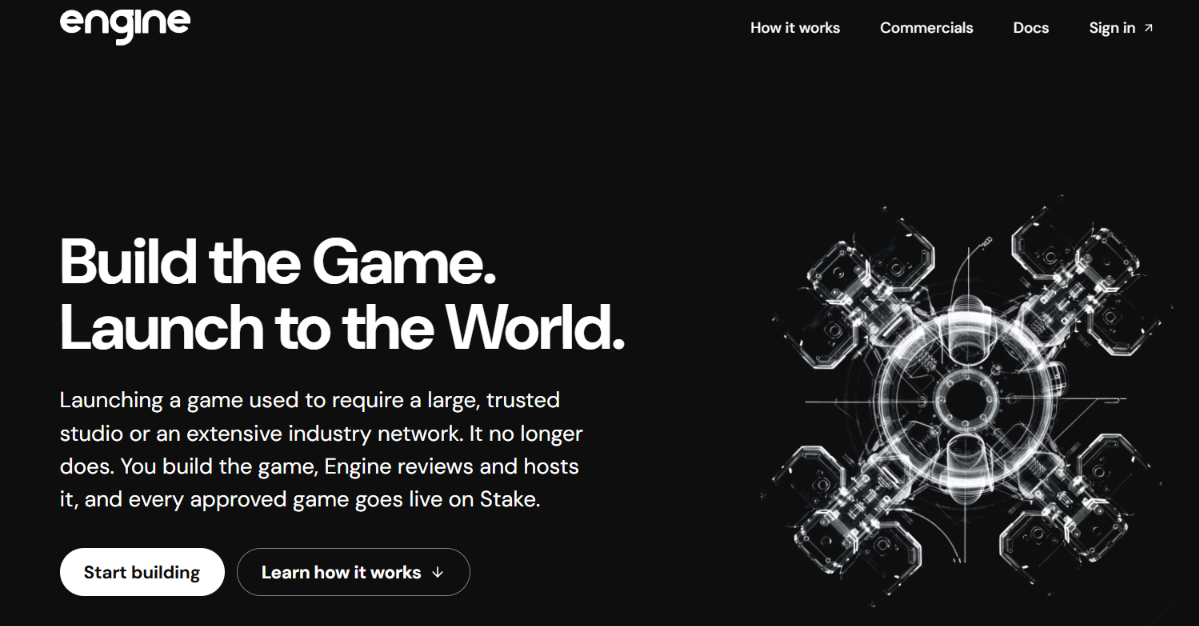
The idea behind it was simple: instead of Stake building every slot in-house or licensing exclusively from established studios, individual creators could use the project’s own development tools to build a game, get it reviewed and approved, and publish it directly into Stake’s live library — without needing an established studio or industry connections to get started.
The model grew fast. By September 2026, the project’s own site reported more than 1,100 creators building on it, with a combined $23 billion-plus in turnover from over 9.7 billion bets placed since launch. On September 15, 2026, Craven announced on X that the platform would drop “Stake” from its name and become simply Engine — and, more importantly for players, that its catalogue would no longer stay exclusive to Stake. Other casino operators can now apply to integrate the same content into their own sites through a single standardized connection, instead of negotiating separately with each individual creator.
How Games on the Engine iGaming Platform Work
The defining feature of games built through this system is provably fair technology. It allows players to verify that a completed round matches the result data published by the platform rather than relying solely on the operator’s claim. In 2026, Engine announced that provably fair technology had gone live across more than 1,200 games. Its public materials state that all games on the platform now use this verification system.
In practice, Engine pre-generates and publishes possible game results together with their selection probabilities. Players can then use the platform’s verification process to confirm that a completed round matches the published data. This provides more transparency than a conventional black-box RNG, but it does not prove that a game offers favourable odds or independently certify its advertised RTP.
When Will the Engine iGaming Platform Reach Other Casinos?
The Engine iGaming platform is not yet live at outside casinos. Although operators can begin the integration process now, external integrations are scheduled to launch on December 11, 2026. Until that date, the catalogue remains exclusively available through Stake.
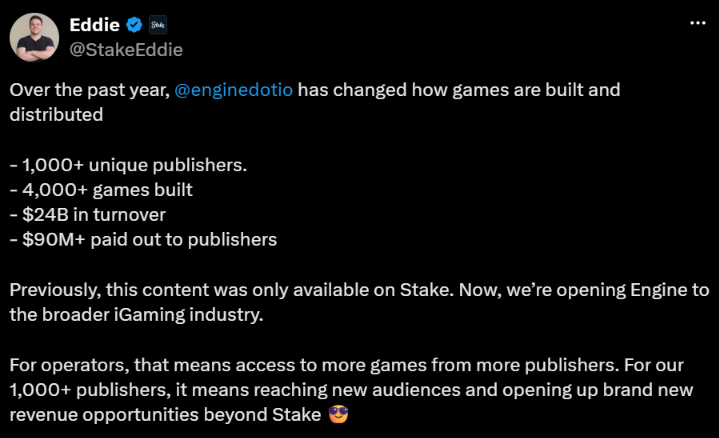
Worth flagging: Engine’s website and Craven’s September 15 post present different headline figures. The website lists 1,100+ creators, 9.7 billion bets, and more than $23 billion in turnover. Craven’s post cites 1,000+ unique publishers, 4,000+ games, $24 billion in turnover, and more than $90 million paid to publishers. The game count and publisher payouts do not appear on the public Engine homepage. These figures may cover different periods or use different definitions, so they should not be treated as directly comparable.
What This Means If You Play at Stake
If you already play at Stake, nothing about the games you use changes immediately. The content remains exclusive to Stake until other operators begin launching their integrations in December. What does change is the underlying business model: a title you enjoy today could, from December onward, also appear at other online casinos. Engine says that its catalogue uses provably fair technology. However, the platform has not yet shown how verification tools will appear inside third-party casino interfaces.
Open Questions: Regulatory Compliance Across Markets
One thing the September announcement doesn’t fully resolve is how compliance will work once these games start reaching regulated European markets through other operators. Gambling software requirements differ significantly by jurisdiction — the UK requires its own gambling software licence, Sweden requires a software supplier permit, and Italy has its own game testing and certification process. Opening the catalogue to operators does not automatically confirm that every title can enter every regulated market without additional licensing, testing or certification.
Public statements do not explain whether Engine, individual creators, casino operators, or another party in the supply chain will handle market-specific approvals. This is a genuine open question rather than a confirmed problem — worth watching if you’re hoping to see this content at a casino licensed in one of these stricter markets specifically.
Final Thoughts
This represents a structural shift in how casino games reach players. The model moves from one operator building or licensing its own catalogue toward creators building games once for distribution through multiple integrated operators. It also gives players a way to verify individual round outcomes instead of relying solely on the operator. The scale is genuinely large: over a thousand creators and billions of dollars in turnover, even while confined to a single operator so far.
That said, the practical impact for most players is still ahead of us. No operator outside Stake has actually gone live with this catalogue yet, the exact scale of the opportunity is described differently depending on which official source you check, and how regulated markets will handle a thousand-creator pipeline remains an open question. Worth revisiting once December 11 arrives and the first outside operators actually go live.
FAQ
Is the Engine iGaming platform related to Socket.IO’s Engine.IO?
No. The Engine platform covered here is a casino-game development and distribution system associated with Stake. Socket.IO’s Engine.IO is an unrelated open-source communication protocol used by software developers.
What types of casino games can developers build with Engine?
Engine’s current public website does not provide a definitive list of supported game categories. It says creators can build and publish casino games, subject to Engine’s review and approval. Developers should check the latest Engine Studio documentation for current technical requirements.
Does an operator need separate agreements with every Engine creator?
Engine says operators will receive access to its creators through one contract, one invoice and one standardized integration. However, Engine does not publicly disclose its complete commercial terms.
How does Engine review games before publication?
The public website states that Engine reviews submitted games and hosts approved titles. It does not publish a complete description of its quality-control or regulatory review criteria.
Can players create games directly through Engine?
Engine targets game developers and studios rather than ordinary casino players. A creator needs to build and submit a functional game for review before Engine can approve it for distribution.
Responsible Gaming Disclaimer
This article is based on Engine’s published materials and public announcements available in September 2026. The platform is developing quickly, and its integration dates, statistics, commercial terms and market availability may change. Players must be at least 18 years old and meet the legal gambling age in their jurisdiction. Gambling involves financial risk and should be treated as entertainment, not as a way to make money. If gambling stops being fun or becomes difficult to control, seek help through responsible gambling resources.